

The Great Indian Paradox: Dalal Street vs Economy Booms
- | Sunday | 6th September, 2026
By Animesh Ikshit
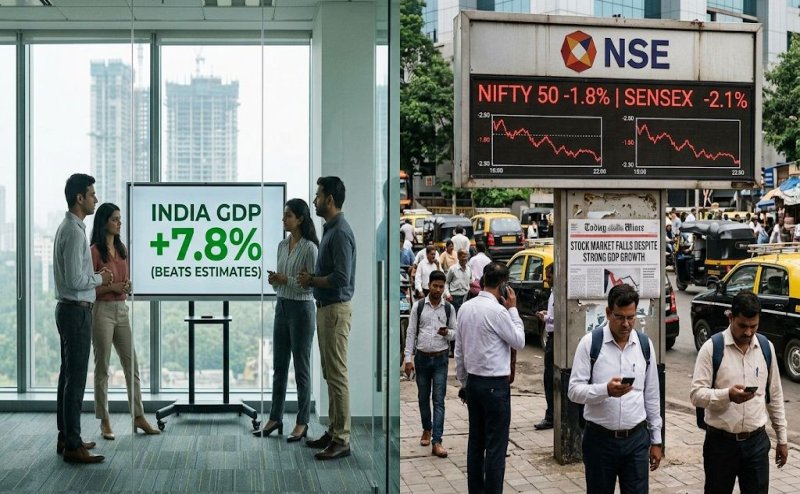
New Delhi: It is the ultimate puzzle currently confounding retail investors and financial veterans alike. On one side of the spectrum, India’s macroeconomic indicators are painting a picture of unrivaled dominance. Recent data shows that the nation`s Gross Domestic Product (GDP) for the first quarter of FY 2026-27 has comfortably beaten estimates, clocking in at a robust 7.8%. The government’s Economic Survey projects a solid 7.4% growth for the fiscal year. We remain the fastest-growing major economy in the world.
Yet, if you look at the screens on Dalal Street, the narrative is completely flipped. The Bombay Stock Exchange (BSE) Sensex and the National Stock Exchange (NSE) Nifty 50 have been surprisingly sluggish, often bleeding in red or trading sideways. Instead of celebrating the macroeconomic triumphs, the Indian stock markets appear to be trapped in a prolonged phase of underperformance and exhaustion.
How does one reconcile this glaring divergence? Why is the stock market failing to mirror the stellar economic growth of the country? For millions of investors looking at their stagnant portfolios, understanding this dichotomy is the need of the hour.
The Macro vs. Micro Disconnect
To crack this paradox, one must first understand that the stock market is not the economy. GDP is a broad, sweeping measure of all economic activity within a country`s borders. It includes colossal government capital expenditure on infrastructure, the agricultural sector, and the vast informal economy areas that contribute massively to the GDP but have little to no direct representation in the stock market indices like the Nifty 50 or Sensex.
The stock market, conversely, is a reflection of corporate earnings, future profitability, and liquidity. While the government is spending heavily to build roads, railways, and defense capabilities, thereby boosting the GDP, corporate India has been grappling with an entirely different set of realities on the ground. A booming GDP does not automatically translate to booming corporate profit margins. In fact, over the last few quarters, corporate earnings growth has been somewhat depressed compared to the high expectations set by investors. The markets are heavily forward-looking; they care less about past economic triumphs and more about future corporate profitability.
The Real Culprits Behind the Market Lull
If the economy is fundamentally sound, what is dragging the NSE and BSE down? The answer lies in a toxic cocktail of global headwinds, valuation concerns, and shifting institutional liquidity.
1. The FII Exodus and Global Geopolitics: No stock market operates in a vacuum. Despite India`s domestic resilience, global macroeconomic factors have cast a long, dark shadow. Geopolitical tensions, notably the ongoing US-Iran conflicts and global trade uncertainties, have spooked global investors. Crude oil prices inching towards the $97 per barrel mark serve as a direct threat to India, a nation that imports over 80% of its crude oil requirements. High oil prices inflate the import bill, widen the current account deficit, and stoke domestic inflation. Consequently, Foreign Institutional Investors (FIIs) have been offloading Indian equities, seeking refuge in safer havens or markets with cheaper valuations.
2. The Valuation Trap: Indian markets have historically commanded a premium over other emerging markets, thanks to our political stability and consistent growth narrative. However, heading into this phase, valuations had become uncomfortably stretched. When a market is priced for perfection, even the slightest moderation in corporate earnings leads to a harsh reality check. We are currently witnessing a "time and price correction." The market is essentially pausing, waiting for corporate earnings to catch up with the high valuations.
3. Margin Pressures on India Inc.: While top-line revenue for many companies has grown, their bottom-line profits have been squeezed. Elevated raw material costs, higher interest rates, and cautious rural consumption have restricted profit margins. The double-engine of consumption and investment is driving the GDP, but the consumption bit has been skewed- premium consumption is thriving, while mass-market volume growth remains tepid, severely impacting the FMCG and retail sectors on the bourses.
When Will the Market Recover?
For the anxious retail investor, the burning question is: When does the tide turn? When will the BSE and NSE start reflecting the 7.8% GDP reality?
Market analysts suggest that the foundation for a massive macroeconomic comeback is already being laid. The recovery, however, will not be an overnight miracle but a staggered, fundamental-driven resurgence. Here are the catalysts to watch out for:
Earnings Catch-up by Q3/Q4: The market will fundamentally pivot when corporate earnings growth aligns with the GDP figures. Consensus estimates point toward a significant pickup in earnings in the coming quarters. As input costs stabilise and rural demand shows signs of revival on the back of favorable monsoons, corporate profit margins are expected to expand. Once India Inc. consistently reports double-digit profit growth, the valuation premium will be justified, and the markets will rally.
Cooling Off of Global Tensions: Any de-escalation in geopolitical theaters or stabilization of global crude oil prices below the $80-$85 mark will act as a massive trigger for the Indian markets. Furthermore, as global central banks shift their interest rate cycles, a weaker dollar could prompt a tsunami of foreign capital back into emerging markets like India.
The Unshakable DII and Retail Support: Historically, FII selling of this magnitude would have triggered a catastrophic crash. That hasn`t happened this time. Why? The absolute powerhouse that is the Indian retail investor. Domestic Institutional Investors (DIIs) and retail mutual fund SIPs are pumping billions into the market every month, acting as a colossal shock absorber. This domestic liquidity floor ensures that when the global macroeconomic clouds part, the Indian stock market will launch from a highly elevated base.
The Verdict
The current phase of market stagnation is not a symptom of economic decay, but rather a necessary digestion period. The stock market is taking a breather, aligning its lofty expectations with ground realities.
For investors navigating this frustrating phase, patience is the ultimate virtue. Trying to time the exact bottom of this consolidation phase is a fool`s errand. Instead, one should look at this underperformance as an accumulation zone. The Indian economic engine is firing on all cylinders, and history is testament to the fact that eventually, stock prices are slaves to corporate earnings. When the earnings catch up, Dalal Street will inevitably reflect the glory of the Indian GDP. Until then, sit tight, trust the broader economic narrative, and let the temporary noise pass.

If You Like This Story, Support NYOOOZ
Your support to NYOOOZ will help us to continue create and publish news for and from smaller cities, which also need equal voice as much as citizens living in bigger cities have through mainstream media organizations.
Stay updated with all the Delhi Latest News headlines here. For more exclusive & live news updates from all around India, stay connected with NYOOOZ.